
Since 1890
The history of the house
The bridge
In the summer of 1891, on the initiative of Tryggvi Gunnarsson, a suspension bridge was built over the Ölfusá river at Selfoss. It was the largest structure Icelanders had ever undertaken, and the bridge was formally opened on 8 September 1891. Bridging Iceland’s most voluminous river was a huge feat for a poor nation. The materials came from England and the master bridge builders were from Newcastle. The materials were landed at Eyrarbakki, and then everyone waited for snow and frost so that it would be easier to haul them the 12 km to Selfoss.
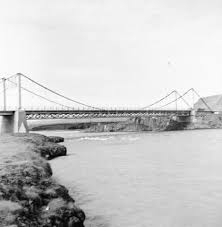
The bridge was a turning point for the settlement at Selfoss. In 1900 there were 40 inhabitants, and today Selfoss is by far the largest town in South Iceland. The main artery of transport in the south was cut when the old Ölfusá bridge gave way under the weight of two lorries on the night of 6 September 1944. The drivers were alone in the vehicles, which plunged into the river when one of the bridge’s main cables snapped. One was unharmed. The other was in grave danger but saved himself, after floating on a tyre some 300 metres down the river. His name was Jón I. Guðmundsson, and he later became chief constable in Selfoss.
Work on a new bridge began at once. The Second World War was coming to an end, so labour was available in Britain and construction went well. The new Ölfusá bridge opened on 22 December 1945, a handsome suspension bridge that still serves us today.
Selfoss
Selfoss is the settlement land of Þórir Hersir Ásason, and the sources also mention Ingólfur Arnarson wintering in 873–74 “under Ingólfsfell, west of Ölfusá”. Few towns in Iceland still have standing the first house built in the settlement. The history of Selfoss is intertwined with the history of Tryggvaskáli, for this was the house that marked the idea of a town centre. Tryggvaskáli housed the first primary school, the first telephone exchange and the first bank in Selfoss, and the list goes on. Tryggvaskáli and Selfoss are still, as they were more than 120 years ago when the bridge was built, a crossroads to all the country’s most popular destinations. The name Selfoss is unusually easy for foreigners compared with most Icelandic place names, so if visitors want to show off, Selfoss is an easy one to say.
The Ölfusá river
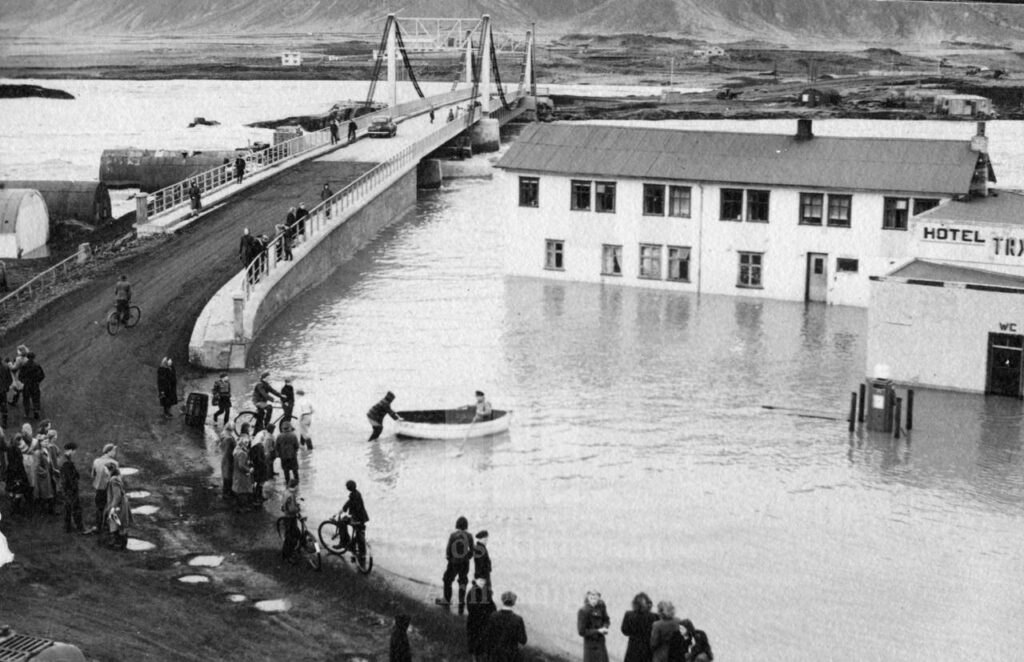
Ölfusá is the most voluminous river in Iceland. It forms where the Sog, which flows from Lake Þingvallavatn, meets the Hvítá, which runs from the Langjökull glacier and passes Gullfoss on its way to the sea. The largest salmon ever caught in South Iceland weighed 39 pounds and was caught in Ölfusá in 1910. Great floods from the river have reached Tryggvaskáli several times. The largest were in 1948 and 1968, when the staff waded in water above their knees and supplies were rescued from the house by boat. It is fun to look at the flood marks on the Ölfusá bridge opposite the west door of Tryggvaskáli.
Jóruklettur is the large rock out in the river opposite Tryggvaskáli. The troll woman Jórunn from Sandvík once flew into a rage when her father’s horse lost a horse fight. She tore a leg off the winning horse and ran to Selfoss, which was then called Laxfoss. The river had no bridge in those days, so, exhausted, she ripped a boulder from the cliffs on the bank and hurled it into the fearsome river. She stepped across on it, saying as she went: “A fitting stride for a maiden; it must be time to marry.” She never did find a husband. Jórunn settled in Mount Hengill, became a terrible ogress and killed men and beasts crossing Hellisheiði.
There is a nykur, a water horse, in Ölfusá, and the farmer Hannes Gíslason of Kotferja saw it in the summer of 1905. He described it as a white horse swimming in the river with its head and mane above the water. This nykur later saved two men from Stóra-Sandvík from drowning when their boat capsized.
In 1907 four men saw a monster in Ölfusá. It was 4–6 metres long and 2–3 metres wide, and the men watched it wallow in the river for about 30 minutes, above Laugardælir. It was black and dome-shaped. There are many accounts of a monster in Ölfusá and Hvítá: several dozen written records, from 1636 to our own time. A few years ago anglers saw the monster at Gíslastaðir, and the dog with them barked furiously at it, having never seen a monster before. Most accounts agree on its size and shape, so it is probably one and the same monster.
Food and lodging
In the spring of 1901 the first innkeeper moved into Tryggvaskáli. He was Þorfinnur Jónsson, and he at once began offering lodging and meals to travellers. Tryggvaskáli was then still in its original form. Þorfinnur bought the house from the county in 1904, the county having bought it from Tryggvi Gunnarsson. He later extended it, and sold it in 1918.
After the Great Frost Winter, Tryggvaskáli changed hands several times over the following years, and meals were always served there. In the spring of 1934 Guðlaugur Þórðarson built an assembly hall onto the house, which transformed the restaurant business and the gatherings held there. Guðlaugur and his daughters ran Tryggvaskáli until 1942.
The hotel and restaurant were a substantial business from 1942 until 1974. The hosts throughout were the couple Brynjólfur Gíslason and Kristín Árnadóttir. Their daughter, Bryndís Brynjólfsdóttir, was later at the forefront of those who saved Tryggvaskáli when it was due to be demolished in the early 1990s. In 1995 she founded Skálavinafélagið, the Friends of the House, together with Þór Vigfússon, Árni Erlingsson and Erlingur Sigurjónsson, and the society led the restoration. They deserve our lasting thanks.
The first native of Selfoss
The stonemason Sigurður Sveinsson, who had worked on the Parliament House in 1880–81, directed the stonework on the Ölfusá bridge and in all likelihood on Tryggvaskáli too. He and his wife, María Matthíasdóttir, spent the winter in Tryggvaskáli. Their son was born there on 13 September 1890, just over a month after the house came into use. He was christened Óskar, and can be counted the first native townsman of Selfoss.
Óskar emigrated alone to North America in 1911 and settled in Winnipeg. There he studied electrical engineering and tinsmithing, and after six years he invented an improvement to electric baking ovens. General Electric wanted to buy the patent from him for 11 thousand dollars, but the young man from Selfoss, ambitious and bold as people from Selfoss are, turned the offer down, meaning to take out the patent and start production himself. That dream did not come true then, because it needed more capital than a young, unknown man could raise.
Óskar married Hansína Amundsen, who was Norwegian-Icelandic, and they moved to Seattle on the Pacific coast of the United States, where Óskar began work at the Boeing aircraft factories in 1933. He had a long and successful career at Boeing, and alongside his work as a foreman he designed new equipment to improve working methods and efficiency. The management honoured him in many ways for his work and extended his employment by four years.
Óskar visited Iceland in 1963 and naturally called at Tryggvaskáli to see the house he was born in. He died on 19 February 1970.
After the earthquake of 1896 the couple at Svarfhóll were left homeless and moved into Tryggvaskáli. A son was born to them there and christened Guðmundur Jónsson.
Tryggvi Gunnarsson
Tryggvi Gunnarsson, member of parliament, always thought big, and more than anyone he is to be thanked for laying the ground on which Selfoss later grew into a town. In 1893 he became Iceland’s first bank manager, as head of Landsbankinn. The bank stood on Bakarastræti, and the street was renamed Bankastræti, so it is fair to say that banks taking things over is nothing new. Tryggvi bought the Þrastarskógur woodland and gave it to the Icelandic Youth Association. He chaired the Icelandic Patriotic Society, sat on Reykjavík town council and chaired the animal protection society from its founding until his death. He sat in parliament for nearly four decades and, among other things, oversaw the building of the Parliament House. He cultivated the garden beside it and in 1917 was buried there, the only Icelander to be so.
Danish kings
In the summer of 1907 King Frederik VIII of Denmark visited Iceland. Great preparations were made, and the king travelled widely. Roads were cleared, the King’s Road was laid, and Frederik and his retinue rode through South Iceland for a week. He called at Tryggvaskáli on 5 August, after visiting Haukadalur, riding up through Hreppar and attending a livestock show at the Þjórsá bridge. A great crowd waited for him at the Ölfusá bridge and Tryggvaskáli and received him with ceremony. The annals record that the king and Hannes Hafstein rode at the head of the procession, which followed the smooth highway west and halted at the Ölfusá bridge. The account books show, on voucher 139, that the Reverend Þórhallur Bjarnarson, who rode in the king’s party, was served 20 bottles of ale at Tryggvaskáli at 35 aurar each, bottles included, 7 krónur in all.
Frederik VIII’s son, King Christian X of Denmark, came to Iceland in 1921, and after travelling all over the south for a week he was given a banquet at Tryggvaskáli. The king dined in the blue room upstairs, which was later, naturally enough, named the King’s Room.
A ghost at Tryggvaskáli
On 30 September 1929 there was a loud knocking at the west door of Tryggvaskáli, and when the innkeeper, Óli J. Ísfeld, opened it he saw a tall, thin woman with a child of 8–10 years. The vision vanished as quickly as it had appeared. It later emerged that she was a maid who was due to start work at Tryggvaskáli that day but had died during the summer, without the news reaching Selfoss. She had been paid in advance for the work, and over the years the staff of Tryggvaskáli have felt a helping hand at busy times.
The Second World War
During the Second World War the British took over Tryggvaskáli as a base and built a camp of Nissen huts across the river. On 9 February 1941 an enemy bomber flew over Tryggvaskáli while soldiers there were preparing for a church service. The plane turned further up the river, and as it came back over Laugardælaeyja there was a sharp burst of gunfire. One man fell: the cook, Martin Hunter, was shot in the head as he looked out of the kitchen window, and died instantly.
Other events
The first Icelandic football championship was held in Reykjavík in 1912, and it was big news that a team from the Westman Islands entered and turned up. Only three teams took part in this tournament, which marked the start of organised football competition in Iceland: KR (then FR), Fram and ÍBV (then KV). It took the KV players two days to reach Reykjavík. They sailed on the Danish ship Pexvie to Stokkseyri and then walked, with their gear on their backs, to Selfoss, where they spent the night at Tryggvaskáli and were served the best salmon they had ever tasted.